
Retail demand can change faster than a planning cycle.
Promotions, seasonal events, consumer preferences, or local demand shifts can quickly accelerate sales for a product that previously sold steadily. Meanwhile, another product staying in a warehouse longer than expected ties up working capital and increases the risk of markdowns.
For supply chain and finance leaders, the challenge is not simply knowing what sold yesterday. It is making better inventory decisions before the next demand shift affects sales, availability, and margins.
This is where AI-powered demand forecasting software can give retail planning teams a stronger basis for decision-making.
How Can AI-Powered Demand Forecasting Help Retailers Predict Customer Demand?
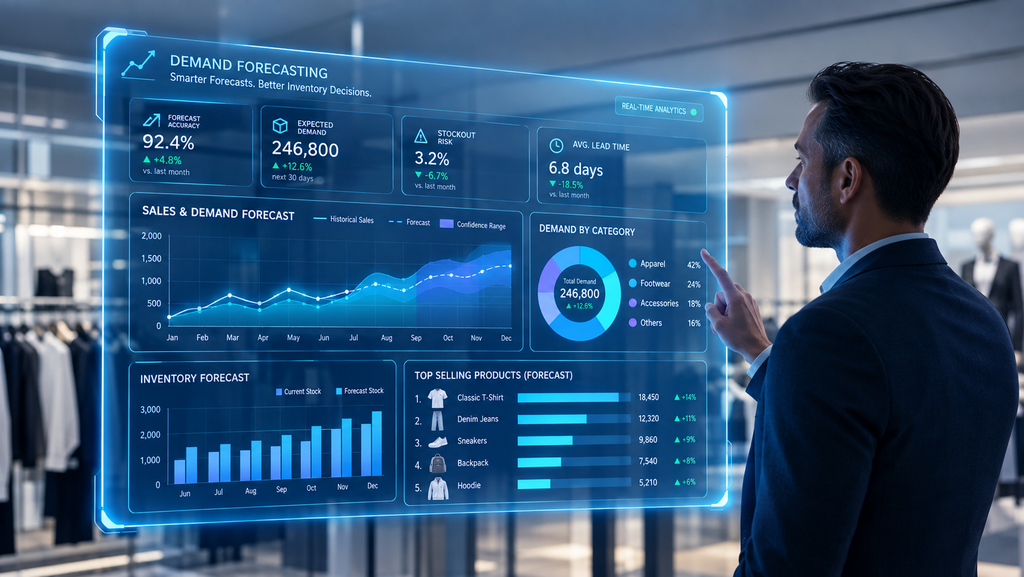
AI-powered demand forecasting software analyzes historical and real-time data to identify patterns and generate forecasts of future demand.
Unlike traditional methods relying on historical averages, AI-powered forecasting analyzes diverse demand signals to better predict changing customer purchasing patterns.
-
- Historical sales and demand patterns
-
- Seasonality and consumer behavior
-
- Promotions and pricing activity
-
- Product and assortment changes
-
- Store and location-level demand
-
- Inventory availability
-
- External factors that can influence purchasing behavior
This allows retailers to build more granular forecasts across products, stores, channels, and planning periods.
For example, a product may show strong historical sales but weakening recent demand. Another product may have modest historical performance but show accelerating demand because of a promotion or seasonal shift. AI-powered forecasting software can identify these changes and continuously adjust forecasts as new data becomes available.
IBM notes that AI demand forecasting can incorporate real-time and historical data alongside external factors to help businesses respond to changing market conditions and consumer behavior. IBM also reports that 88% of retail executives see demand forecasting as a key area for improvement through AI.
For retail planning teams, this creates a more dynamic view of demand and a stronger basis for deciding how much inventory to carry, where to position it, and when replenishment needs to happen.
How Does AI Forecasting Improve Inventory Decisions?
A more accurate view of future demand can directly influence how retailers manage inventory. For planning and operations teams, the objective is to maintain product availability without committing too much capital to inventory that may not sell.

Reduce Stockouts and Recapture Lost Sales
When demand increases unexpectedly, replenishment decisions based only on historical averages can leave retailers reacting too late.
AI-powered demand forecasting can identify changes in demand earlier and help planning teams determine where additional inventory may be required. This is particularly important for fast-moving products, seasonal items, promotional periods, and locations with significantly different demand patterns.
A study by Bandaru (2026) found that AI-driven demand forecasting can improve forecast accuracy, reduce stockout rates and inventory holding costs, and increase inventory turnover. The study also found that these improvements were particularly pronounced in product categories with high demand variability.
Better forecasting does not guarantee that stockouts will disappear. It gives retailers a better opportunity to identify demand changes early enough to act on them.
Reduce Overstock and Free Up Working Capital
Inventory planning is also about knowing when not to buy more.
Overestimating demand can leave retailers with excess stock that occupies warehouse and store capacity, increases carrying costs, and may eventually require markdowns. For CFOs and COOs, this also means working capital remains tied up in products that are not generating revenue quickly enough.
AI-powered forecasting can help identify where expected demand does not justify current or planned inventory levels. By continuously incorporating updated demand signals, retailers can adjust purchasing, allocation, and replenishment before excess inventory becomes a larger problem.
IBM identifies reducing excess inventory, optimizing inventory levels, and lowering carrying and storage costs among the potential benefits of AI-powered inventory management.
Improve Replenishment Decisions
Forecasting becomes more valuable when it directly informs replenishment.
Retailers need to determine not only what customers are likely to buy, but also how much inventory is needed, where it should be available, and when it needs to be replenished.
AI-powered forecasting and replenishment software can connect expected demand with inventory positions, supply constraints, lead times, promotions, and other planning variables. This allows replenishment decisions to respond to changing demand rather than relying solely on fixed rules or manual intervention.
The result is a more connected planning process where demand forecasts can translate into timely inventory actions.

How Can genieX Help Retailers Make Better Demand Planning Decisions?
For retailers, the value of AI-powered demand forecasting lies in what teams can do with better demand insights. More responsive forecasts can help planning teams act earlier on changes in customer demand, reducing the risk of lost sales and excess inventory while supporting more disciplined inventory and replenishment decisions.
Better forecasting can also have a direct impact on how efficiently retailers use their working capital. By aligning inventory more closely with expected demand, businesses can reduce the amount of cash tied up in slow-moving or excess stock while keeping high-demand products available where customers are most likely to buy. This can help retailers improve inventory turnover, protect product availability, and capture sales that might otherwise be lost because the right products were not available at the right time.
Through its technology partnerships, genieX provides access to solutions that help retailers strengthen demand planning and supply chain operations. One of these is RELEX, an AI-powered planning solution with capabilities across demand forecasting, inventory optimization, and replenishment.
With RELEX, retailers can use AI-powered forecasting to respond to changing demand patterns and support more informed decisions across their operations.
AI cannot predict every customer purchase with certainty. But with the right forecasting and replenishment technology, retailers can make more informed decisions about where inventory is needed, when to replenish, and how to balance product availability with working capital.
The goal is not to predict every purchase perfectly, but to make every inventory decision more informed. With better demand signals and the right technology behind them, businesses can stay responsive to changing customer needs while keeping inventory productive and operations ready for what comes next.
About genieX
genieX provides end-to-end retail and supply chain technology solutions, headquartered in the Philippines and supported by global partners. Through a consulting-first approach, genieX helps businesses redesign processes and integrate advanced technologies. From forecasting and demand planning, through warehouse management systems and transport management systems, to retail POS systems, genieX enables organizations to make data-driven decisions, optimize operational performance, and support long-term business growth.