

Expanding to multiple warehouses can help businesses support growing order volumes, improve delivery coverage, and position inventory closer to customers. However, as stock is distributed across more locations, accurate inventory tracking becomes increasingly difficult.
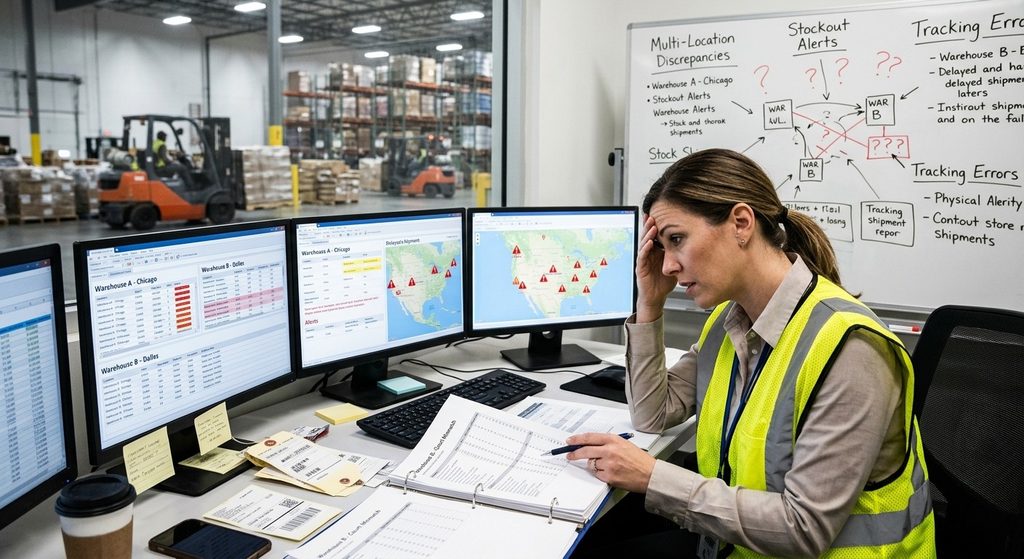
A product may be available in one warehouse but out of stock in another. Transfers between facilities may not be recorded promptly, while different teams may use separate spreadsheets or systems to track inventory. Over time, these gaps can lead to stock discrepancies, excess inventory, delayed fulfillment, and inefficient use of warehouse capacity.
The challenge is no longer simply knowing how much inventory the business has. It is knowing where inventory is, how it is moving, and whether it is available where it is needed.
What Inventory Challenges Arise When Managing Multiple Warehouses?
Managing inventory across multiple warehouses introduces more points where errors, delays, and inconsistencies can occur.
Each facility may receive, store, transfer, pick, and ship inventory independently. Without a centralized view, teams can struggle to determine the actual availability of stock across the network. Unrecorded transfers create discrepancies, while uneven inventory distribution leads to overstocking in one warehouse and shortages in another.
Businesses may also face:
- Limited inventory visibility: Teams cannot easily see available stock across all locations.
- Stock discrepancies: Physical inventory may not match system records because of manual updates or delayed transactions.
- Inefficient inventory transfers: Stock may not be moved between warehouses at the right time or in the right quantities.
- Slower fulfillment: Teams may spend more time locating and coordinating inventory before orders can be processed.
- Uneven warehouse performance: Differences in processes and workloads can make some facilities less efficient than others.
As the warehouse network grows, these challenges become harder to manage through spreadsheets and disconnected systems.
How Can Businesses Improve Inventory Visibility Across Multiple Warehouses?
A centralized inventory system improves visibility by providing teams with real-time stock updates across all warehouse locations.
Teams can track inventory locations, available stock, and transfers across warehouses in one centralized system, eliminating the need for separate records. This makes it easier to identify available inventory and determine which warehouse can fulfill a particular requirement.
A Warehouse Management System (WMS) supports this visibility by keeping inventory information updated as warehouse activities are recorded. This creates a consistent view of inventory across warehouses and minimizes manual reconciliation of stock records between facilities.
Improved visibility helps procurement, warehouse, operations, and logistics teams use shared inventory data to guide allocation, transfers, and fulfillment decisions.
How Do Businesses Reduce Inventory Errors and Stock Discrepancies Across Multiple Warehouses?
Discrepancies can occur when stock is received, transferred, picked, or shipped without being accurately reflected in inventory records. These gaps become more difficult to identify when the same products are moving between multiple facilities.
A WMS can provide greater traceability by recording inventory movements and supporting processes such as barcode scanning and RFID. This creates a clearer record of where inventory came from, where it was moved, and how it was processed, making discrepancies easier to identify and investigate.

How Can Companies Optimize Operations Across Several Warehouses?
Businesses can improve warehouse efficiency by reducing unnecessary movement and manual work during daily warehouse activities.
When time is spent searching for products, assigning storage locations, or coordinating picking and replenishment manually, warehouse capacity may not be utilized efficiently.
A WMS can help optimize warehouse execution through capabilities such as directed putaway, picking processes, mobile applications, voice picking, and automated replenishment. These tools can help employees locate inventory more efficiently and execute routine tasks with less manual intervention.
For businesses operating several facilities, these tools can help maximize existing warehouse capacity while enabling teams to use their time and manpower more effectively.
How genieX Helps Businesses Manage Multiple Warehouses
For businesses expanding their warehouse network, maintaining inventory control requires visibility across locations, accurate inventory records, and efficient warehouse execution.
To support multi-location warehouse operations, genieX partners with established WMS providers such as Blue Yonder and SCM Profit, bringing businesses access to warehouse technologies suited to their operational needs. Through these WMS solutions, businesses can access capabilities such as real-time inventory visibility, barcode and RFID processes, mobile warehouse operations, automated replenishment, and warehouse analytics, helping them maintain greater control over inventory and warehouse activities.
These WMS solutions can also connect with other business systems, including ERP, Order Management Systems (OMS), Transportation Management Systems (TMS), eCommerce platforms, marketplaces, CRM platforms, and forecasting and replenishment solutions. As a result, data can move more consistently between warehouse activities and the systems responsible for inventory, orders, fulfillment, and broader supply chain processes.
As businesses expand to multiple warehouses, the goal is not simply to add more storage locations. It is to maintain control over inventory across the entire network. With the right warehouse technology in place, businesses can gain clearer visibility, improve inventory accuracy, and make better use of warehouse resources as operations grow.
Connecting Warehouse Operations and Transportation
Beyond its Warehouse Management System (WMS), genieX also offers a Transportation Management System (TMS) through Smartlinks. While each solution serves a distinct purpose, they work together to create a more connected, visible, and efficient supply chain.
The WMS focuses on optimizing warehouse operations from inventory management and stock handling to order processing, picking, packing, and fulfillment. Meanwhile, the TMS focuses on optimizing transportation processes, including route planning, shipment scheduling, dispatch management, carrier coordination, and delivery tracking.
Although they operate as separate solutions, integrating the WMS and TMS enables businesses to coordinate warehouse activities with transportation requirements more effectively. With improved visibility into inventory, order readiness, shipment status, and delivery progress, teams can make better-informed decisions, reduce operational delays, and ensure smoother handoffs from the warehouse to the final destination.
About genieX
genieX provides end-to-end retail and supply chain technology solutions, headquartered in the Philippines and supported by global partners. Through a consulting-first approach, genieX helps businesses redesign processes and integrate advanced technologies. From forecasting and demand planning, through warehouse management systems and transport management systems, to retail POS systems, genieX enables organizations to make data-driven decisions, optimize operational performance, and support long-term business growth.